

Last Updated: November 2, 2026
Quick Summary
To identify authentic handmade quilts, flip the quilt over and inspect the stitches first: hand-quilted stitches vary slightly in length and tension, while machine work stays uniform and ruler-straight. Slight irregularities are a good sign, and printed fake stitch patterns feel flat under a fingernail.
- Hand-guided needles usually produce stitches varying from a few millimetres to a centimetre.
- Hand stitches feel softer and can be eased with a fingertip, unlike tight machine tension.
- Check fabric grain, seam allowance, and binding, since knife-edge finishes signal skill.
- Verify the maker's mark by searching the exact name or initials with your region.
- Wash gently in cold water, skip bleach, tumble dry low, and store away from sunlight.
Table of Contents
- How to Tell If a Quilt Is Handmade: Start With the Stitches
- Hand-Quilted vs Machine-Quilted: Reading the Stitch Tension
- Signs of a Quality Handmade Quilt Beyond the Stitching
- Provenance, Documentation, and Grading: What Paperwork Proves
- How to Care for a Handmade Quilt So It Lasts
- Choosing Your First Handmade Quilt at Eboni & Comfort LLC
- Frequently Asked Questions
How to Tell If a Quilt Is Handmade: Start With the Stitches
Learning how to identify authentic handmade quilts starts with one inspection point: the stitches. At Eboni & Comfort LLC, we tell buyers to flip the quilt over before anything else. The back tells the truth the front tries to hide. Hand-quilted stitches rarely look identical to one another, and that small flaw is exactly what you want to see.
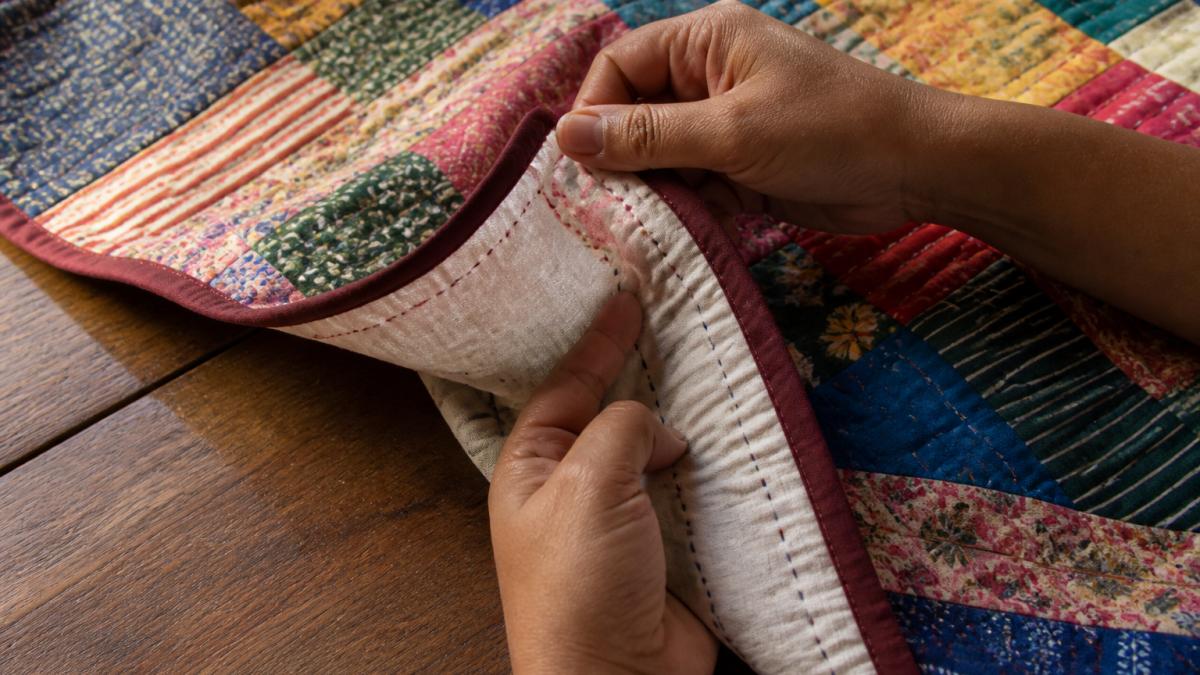
Examining Stitching Quality and Stitch Length
Look for stitch consistency across the quilt top, not perfection. Hand-guided needles produce stitches that vary slightly in length, usually somewhere between a few millimetres and a centimetre. Machine-quilted pieces show near-identical stitches running in perfectly straight lines. A maker's hand wobbles. A computer's does not.
A practical way to read this is to measure a short run of stitches with a ruler and compare it to another run on the same quilt. Most hand-quilted pieces show a rhythm that shifts by a millimetre or two as the quilter moves across the frame; machine work holds the same count per inch across the whole surface. Check the stitch tension too. Hand stitches sit slightly looser and can be eased with a fingertip. Tight, rigid, uniform tension across an entire quilt points to a machine.
Why Uneven Stitches Can Be a Good Sign
This is the part most guides get wrong. Slight irregularities are evidence of human work, not sloppiness. A quilter working on a quilting frame guides the needle by hand, and her rhythm shifts as she moves across the quilt top. Perfectly even stitches on a large piece are a red flag, not a badge of quality.
Watch out: some mass-produced quilts are printed with fake stitch patterns. Run your fingernail across the surface. Real quilting stitches can catch slightly, while printed ones tend to feel flat.
A Macro-Photography Check You Can Do With a Phone
A phone camera with a macro mode or a clip-on lens can help you compare stitch detail across a quilt. You might photograph a center block, an outer border, and a corner to see whether the stitching looks consistent across the surface.
Hand-Quilted vs Machine-Quilted: Reading the Stitch Tension
The difference between hand-quilted vs machine-quilted comes down to how the three layers are joined. Hand-quilting uses a needle and thread pushed through by hand, one stitch at a time. Machine quilting uses a long-arm machine that moves the fabric or the head automatically.
Here is how to tell them apart:
- Stitch length: hand work varies; machine work stays uniform
- Stitch line: hand lines drift slightly; machine lines stay ruler-straight
- Tension: hand stitches feel softer and more giving
- Backstitching: hand-finished pieces often show small securing stitches at the ends
- Speed markers: machine-quilted pieces may show faint drag lines where the fabric was pulled
A hand-stitched quilt generally takes longer to make than a machine-quilted one.
Here is how hand-quilted and machine-quilted work differ on the points that matter most.
| Feature | Hand-quilted | Machine-quilted |
|---|---|---|
| Stitch length | Varies | Stays uniform |
| Stitch line | Drifts slightly | Stays ruler-straight |
| Tension | Softer and more giving | Tight, rigid, uniform |
| Backstitching | Small securing stitches at ends | Not noted |
| Speed markers | Not noted | May show faint drag lines |
| Time to make | Generally longer | Shorter |
Signs of a Quality Handmade Quilt Beyond the Stitching
Stitching is the first check, not the only one. Signs of a quality handmade quilt show up in the materials and the finishing. Pull the quilt up to a window and look through it. Even light through the layers tells you a lot about what is inside.
Batting, Fabric Grain, and Seam Allowance Checks
Batting is the middle layer that gives a quilt its warmth and loft.
Next, check the fabric grain. Woven cotton has a visible direction. On a well-made quilt, the patchwork pieces line up with the grain rather than running diagonally, which keeps the quilt from twisting over time.
Look at the seam allowance on the back. Neat, consistent seam widths are generally a sign of careful work.
Knife-Edge Finishes and Binding Details
The binding is the strip that finishes the outer edge. A knife-edge finish folds the front and back fabrics together with no separate binding strip, giving a clean, flat edge. It is harder to sew than a standard binding, so it signals skill.
Check the corners. Hand-finished corners are folded with care. Sloppy corners pucker or gap. Small details like these separate heirloom quality from mass-produced work.
Provenance, Documentation, and Grading: What Paperwork Proves
Paperwork matters more than most buyers expect. A genuine artisan piece often comes with a maker's note, a fabric list, or a signed card. Ask the seller who made the quilt and where. A real maker has a name, a story, and a workspace.
Fiber content and care details are worth asking a seller to document.
How to Verify a Maker's Mark and Date a Quilt
Most guides skip the actual verification step, so here is a practical method. Start with the maker's mark: a signature, embroidered initials, or a fabric label. Photograph it and search the exact name or initials alongside the word "quilt" and your region. Many quilters maintain public guild profiles, exhibition records, or social accounts that confirm a body of work. A mark that returns no traceable maker is a question, not automatically a fake, but it should lower your confidence.
Next, date the materials. Fabric prints and selvage markings are the most reliable clues. Selvage edges often carry a manufacturer name and a registration or copyright date; a print that postdates the claimed age of the quilt is a contradiction worth asking about. A common pattern is for a quilt to be described as "vintage" when the fabric selvage shows a much later print run.
Finally, read the documentation for specificity. A real maker's note names the pattern, the fabrics, the batting, and the date. Vague language like "assorted cottons" or "made by hand" with no name is a weak signal. Ask for the maker's full name, the year completed, and whether the quilt was made for sale or as a gift; a gift quilt often has a story that can be corroborated.
Standardized Grading and Appraisals
Standardized grading systems for handmade quilts are not common, which is why documentation fills the gap. There is no single industry-wide quality scale for handmade goods the way there is for some collectibles, so buyers rely on condition reports and appraisals. An appraisal from a textile professional can confirm value for insurance or resale, and a written condition report should note stains, fading, seam stress, and any repairs. Ask whether the appraisal is for replacement value or fair market value, because the two numbers differ and serve different purposes.
For a deeper look at whether the price reflects real value, read are sustainable artisan quilts worth the investment.
How to Care for a Handmade Quilt So It Lasts
Knowing how to care for a handmade quilt protects both the fabric and your investment. The short answer: wash gently, dry low, and keep it out of direct sun.
A simple routine:
- Machine wash on a gentle cycle in cold water with a mild detergent
- Skip bleach entirely
- Tumble dry on low heat and remove promptly
- Store folded in a cool, dry place away from sunlight
- Air it out seasonally rather than washing often
Harsh detergent and high heat can damage fabric and dull colors. For a full walkthrough, see the best way to wash handmade quilts without damage.
Choosing Your First Handmade Quilt at Eboni & Comfort LLC
Ready to buy? Start with size and use. A lap quilt suits a reading chair. A larger throw works on a bed or sofa.
Our Ripples Handmade Quilt measures 43" x 58" and uses an ocean palette of blue, aqua, green, black, and white in a geometric patchwork design. The Earth Love Handmade Quilt runs 59" x 73" with nature-inspired earth tones and blue-green prints. Both are handmade, one-of-a-kind pieces, ready to ship, and machine washable on a gentle cold cycle.
Browse the Ripples Handmade Quilt or the Earth Love Handmade Quilt to compare sizes and palettes side by side.


Frequently Asked Questions
How can you tell if a quilt is handmade or machine-made?
Turn the quilt over and check the stitching lines. Handmade quilts usually show small irregularities in stitch length and tension, while machine-quilted pieces have near-perfect, uniform stitches. Look at the quilt top, backing fabric, and binding for slight variations. A handmade quilt will also have visible human decisions in color placement and patchwork seams that a mass-produced quilt rarely shows.
Are uneven stitches a sign that a quilt is handmade?
Yes, small irregularities are one of the clearest signs. Hand-guided needles produce stitches that vary slightly in length and spacing, especially across a large quilting pattern. Perfect uniformity across every inch usually points to a machine. That said, uneven stitches alone do not prove quality. Check seam allowance, fabric grain, and batting consistency too before you decide.
What should I look for when buying a handmade quilt online?
Ask for close-up photos of the stitching, the quilt top, and the backing. Look for stitch consistency, a clean knife-edge or binding finish, and fabric that follows the grain. Request details on fiber content and batting. Reputable sellers like Eboni & Comfort list care instructions and describe each piece as one-of-a-kind, which is a strong signal that the quilt was made by hand rather than mass-produced.
How do I care for a handmade quilt without damaging it?
Machine wash on a gentle cycle in cold water with mild detergent, then tumble dry on low heat and remove promptly. Avoid bleach and prolonged direct sunlight, which fades fabric colors. Store the quilt in a cool, dry place when not in use. These steps match the care instructions on handmade quilts from Eboni & Comfort and are designed to keep your quilt looking its best.
The real test of a handmade quilt is whether the story behind it holds up under close inspection. At Eboni & Comfort LLC, every quilt is a one-of-a-kind handcrafted piece, professionally quilted for durability and texture. Compare the Ripples and Earth Love designs in our catalog, check the stitching for yourself, and choose the piece that fits your space. Get started with Eboni & Comfort LLC and bring a genuine artisan quilt into your home.
