

Last Updated: October 30, 2026
Quick Summary
Handmade bedding is quilted, pieced and finished by an individual maker rather than a factory line, so every quilt is a one-of-a-kind piece. The benefits include softness that improves with every wash, breathable natural fibers for better sleep, and durability you can inspect stitch by stitch. Handmade bedding typically costs more up front than mass-produced alternatives.
- Cotton quilts with natural batting soften and develop a crinkled loft with each gentle wash.
- Quilts layered with natural batting, such as Warm & Natural batting, are described as warm and breathable.
- A throw of roughly 43 by 58 inches suits a lap, a couch or a wall hanging.
- Machine wash most cotton quilts with natural batting on a gentle cold cycle with mild detergent.
- The biggest care mistake is overdrying, since high heat shrinks cotton and dulls dyes.
Table of Contents
- Why Handmade Bedding Feels Different From the Start
- 1. Softness That Improves With Every Wash
- 2. Better Sleep Through Breathable Natural Fibers
- 3. Durability and Longevity You Can Inspect Stitch by Stitch
- What Is Quilt Batting Made Of and Why It Decides Comfort
- How to Choose a Handmade Quilt That Fits Your Home
- Handmade vs. Mass-Produced Bedding: Price, Value and What You Pay For
- Handmade Quilt Care Without the Dry-Cleaning Bill
- Frequently Asked Questions
Why Handmade Bedding Feels Different From the Start
Handmade bedding is quilted, pieced and finished by an individual maker rather than a factory line, and that difference shows up the moment you unfold it. Every quilt is a one-of-a-kind handmade piece, which means the benefits of buying handmade bedding start with something mass production cannot copy: a specific person made this specific item.
Most bedding sold in volume is built to a price. Handmade quilts are built to a pattern, a palette and a standard. Handmade quilts are assembled through hand-selected fabrics, layered batting and quilted stitching.
Here is what that actually gets you.
1. Softness That Improves With Every Wash
Machine-made bedding often peaks on day one. Cotton quilts with natural batting do the opposite: the fibers relax with each gentle wash, and the quilt develops a soft, crinkled loft that feels better in year two than it did in week one.
The reason comes down to construction. Quilts with natural batting and dense stitching have room to move and settle, while bedding with sparse stitching can stiffen over time.
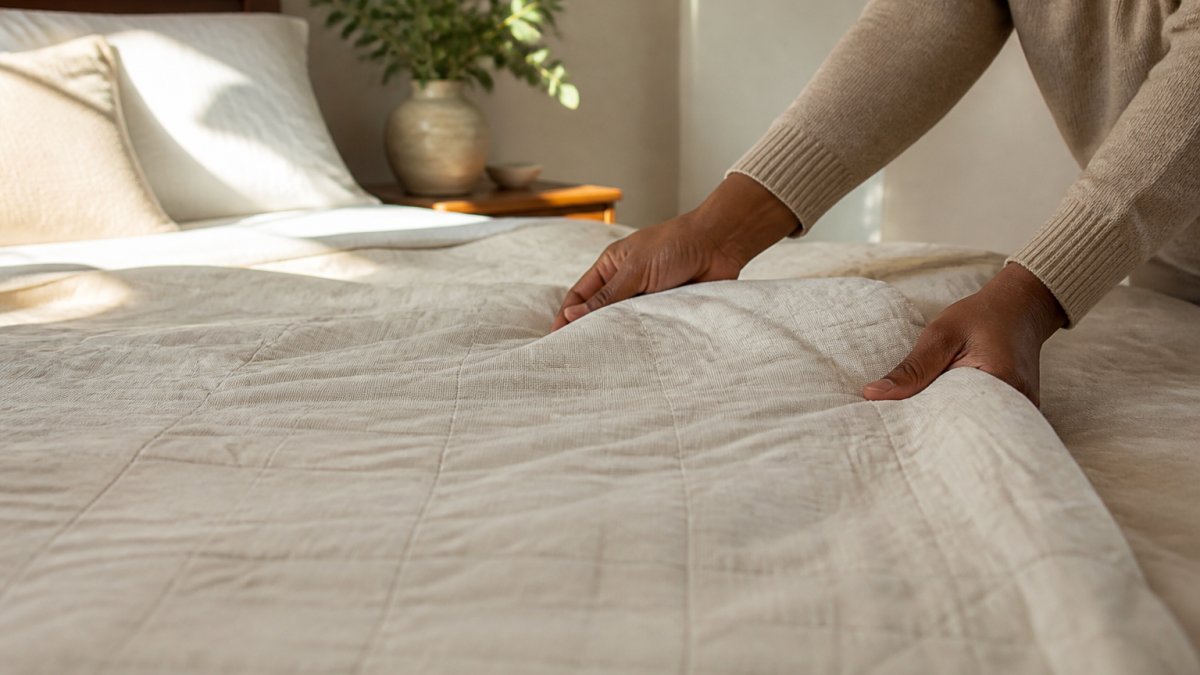
A common mistake is washing a new quilt in hot water with a strong detergent. That strips the natural finish before the fibers have had a chance to relax. Cold water and a mild detergent protect the softening process.
2. Better Sleep Through Breathable Natural Fibers
Better sleep starts with temperature regulation, and natural fibers handle that job better than synthetic fills. Cotton breathes. It moves moisture away from your body instead of trapping it, which is why a cotton quilt feels comfortable across a wider range of room temperatures.
The filling matters as much as the shell. Quilts layered with natural batting, such as Warm & Natural batting, are described as warm and breathable.
If you sleep hot, or you share a bed with someone who does, breathability is the specification that decides comfort. Look for a cotton top, a cotton fleece backing and natural batting when choosing a quilt.
3. Durability and Longevity You Can Inspect Stitch by Stitch
Durability in handmade bedding is not a claim on a label. It is visible in the stitching, the fiber content and the finishing, and you can check all three before you buy.
Start with the quilting itself. Dense, even lines running across the entire face hold the three layers together through repeated washing, which is where cheap bedding fails first. Loose or sparse stitching lets batting shift and bunch, and once that happens the quilt never lies flat again. A useful check is to hold the quilt up to a window: if light shows uneven gaps between stitch lines, the batting has room to migrate. Edge-to-edge stitching can reinforce the fabric against washing and add textured loft.
Then look at the fibers. Natural fibers age differently from synthetics. Cotton softens and develops a crinkled drape; wool resists compression and rebounds; linen grows stronger when damp and tolerates frequent washing. Polyester batting is inexpensive and lofty at first, but it tends to clump and pill, and it does not recover its loft the way natural batting does. The fiber choice is therefore a longevity decision, not just a comfort one.
Finishing details separate a quilt that lasts from one that frays. Check the binding along the edges for double-fold construction and secure stitching, inspect the seams for even tension, and look for quilting that extends into the border rather than stopping short. These are the stress points where wear shows up first.
Watch out: store quilts in a cool, dry place when not in use.
A well-made quilt is also repairable in a way mass-produced bedding is not. Worn seams or patches can often be re-stitched by a skilled quilter, which can extend the working life of a quilt. Ask the maker whether they offer repairs before you buy.
What Is Quilt Batting Made Of and Why It Decides Comfort
Quilt batting is the middle layer of a quilt, and it is made from fibers such as cotton, wool, bamboo or polyester. Batting affects how warm, heavy and breathable the finished quilt feels.
The trade-offs are straightforward:
- Cotton batting: breathable, medium weight, develops a traditional crinkled look, holds up well to washing
- Wool batting: warmest option, naturally temperature-regulating, needs gentler care
- Bamboo batting: soft drape, light weight, less springy over time
- Polyester batting: inexpensive and lofty, but traps heat and can pill
How to Choose a Handmade Quilt That Fits Your Home
Choosing a handmade quilt comes down to three decisions: size, palette and purpose. Get those right and the quilt works in your space for years.
Size first. Measure the bed, chair or wall you have in mind. A throw of roughly 43 by 58 inches suits a lap, a couch or a wall hanging. A larger piece around 59 by 73 inches covers a bed overlay or a generous couch drape.
Palette second. Pull one or two colors from the room and let the quilt carry them. A water-inspired palette like the Ripples Handmade Quilt suits calm, coastal interiors. Earth tones and greens suit warmer, natural interiors.

Purpose third. Will it be used daily, displayed as textile art, or given as a gift? Daily-use quilts should have sturdy quilting and washable materials. Display pieces can lean toward intricate patchwork.
If you want to browse finished options before deciding, explore our catalog.
| Decision | What to Check | Why It Matters |
|---|---|---|
| Size | Measure bed, chair or wall | Prevents a throw that is too small for the space |
| Palette | Match 1-2 room colors | Keeps the quilt looking intentional, not added on |
| Purpose | Daily use vs. display vs. gift | Sets the right quilting density and care routine |
| Batting | Cotton, wool, bamboo or blend | Decides warmth, breathability and how it ages |
| Stitching | Dense, even lines across the face | Predicts how it survives washing |
Handmade vs. Mass-Produced Bedding: Price, Value and What You Pay For
Handmade bedding typically costs more up front than mass-produced alternatives. Readers weighing that cost can explore whether sustainable artisan quilts are worth the investment.
Mass-produced bedding wins on one measure only: the sticker price.
How to verify handmade claims. Because 'handmade' is not a regulated term, it is worth asking any seller where the fabric and batting were sourced, who did the cutting and quilting, and where the piece was made. For labor and environmental claims, third-party textile certifications can be more reliable than marketing language.
Sizing and returns. Measure the bed, chair or wall first, because a quilt made to the wrong size can be hard to exchange. Check the return policy before ordering.
Handmade Quilt Care Without the Dry-Cleaning Bill
Handmade quilt care does not require a dry cleaner. For step-by-step instructions, see the best way to wash handmade quilts without damage. Most cotton quilts with natural batting can be machine washed on a gentle cold cycle.
Follow this routine:
- Machine wash on a gentle cycle in cold water with a mild detergent
- Skip bleach and fabric softener entirely
- Tumble dry on low heat, or line dry to preserve dyes
- Remove promptly from the dryer to avoid set-in wrinkles
- Keep the quilt out of prolonged direct sunlight to protect the colors
- Store folded in a cool, dry place when it is not in use
Watch out: the biggest care mistake is overdrying. High heat shrinks cotton and dulls dyes.
Frequently Asked Questions
Is handmade bedding worth the higher price?
It depends on what you are comparing. A mass-produced quilt is cheaper up front. Eboni & Comfort quilts run from $100 for the Baby Blue Artisan Quilt to $325 for Earth Love, and each is a one-of-a-kind piece.
How do you care for a handmade quilt?
Handmade quilt care is simpler than most people expect. Machine wash on a gentle cycle in cold water with a mild detergent, skip bleach entirely, and tumble dry on low heat or line dry. Remove it promptly from the dryer to avoid setting wrinkles. Keep quilts out of prolonged direct sunlight so the dyes stay vivid, and store them in a cool, dry place when not in use. The listings for Eboni & Comfort quilts include care instructions.
What should you look for when buying a handmade quilt?
Start with the batting, because it decides warmth and drape. Warm & Natural cotton batting, used across the Eboni & Comfort range, gives breathable heirloom weight. Check the backing (100% cotton fleece here) and confirm the quilting is stitched edge to edge rather than tacked at intervals, since that is what prevents bunching. Then match size to purpose: a 35" x 36" Baby Blue is sized for a car seat, stroller or play mat, while a 59" x 73" Earth Love works as a throw or couch quilt.
How can I tell if bedding is genuinely handmade?
Ask for specifics rather than adjectives. A real maker can tell you the batting brand or fiber, the backing material, the quilting style and the exact dimensions. Look for slight variation between pieces, since one-of-a-kind handcrafted work is never perfectly identical, and check that care instructions are detailed enough to be real. Vague claims like artisan-inspired with no material list are a warning sign. Eboni & Comfort product listings include dimensions, materials and care instructions.
The real test of handmade bedding is not how it looks on day one. It is how it feels after a year of washing, whether it still lies flat, and whether you would buy it again. That is the standard we build to at Eboni & Comfort LLC: one-of-a-kind artisan quilts with cotton tops, natural batting and longarm quilting that holds up to real use. Browse the collection to find a piece that fits your room, your palette and the way you actually live.
