

Last Updated: October 25, 2026
Quick Summary
Style handmade quilts for nursery decor by letting the quilt lead the room: pull three colors from it, choose a wall color one shade lighter, and keep it the only patterned object. Display it on a wall at least 12 inches above the crib rail, never inside the crib.
- Pull one dominant, one secondary, and one accent color from the quilt, then trace every later decision back to those three.
- Hang the quilt's center roughly 57 to 60 inches from the floor so it reads at eye level like framed art.
- Leave 12 to 18 inches between the bottom of a wall quilt and the top of the crib rail.
- Rotate a displayed quilt every three to six months and refold along different lines to avoid uneven fading and creases.
- Machine wash cold on gentle with mild detergent, skip bleach and fabric softener, and store folded in a breathable cotton bag.
Table of Contents
- Why Handmade Quilts Belong in Nursery Decor
- Handmade Baby Quilts: What Sets Artisan Pieces Apart
- Handmade Crib Quilts: Sizes, Placement, and Safe Use
- Nursery Color Scheme Ideas That Work With Quilts
- Baby Quilt Display Ideas for Walls and Shelves
- Washing, Storing, and Preserving a Keepsake Quilt
- Choosing Your Nursery Quilt From Eboni & Comfort LLC
- Frequently Asked Questions
Why Handmade Quilts Belong in Nursery Decor
A handmade quilt is a crib-sized textile pieced, layered, and stitched by one maker rather than a factory line, and that single fact changes what the piece does in a nursery.
Most nursery bedding gets outgrown and binned within two years. A handmade quilt stays. It becomes the blanket in the toddler bed, then the wall hanging in the big-kid room, then the keepsake folded in a chest.
The difference between handmade and mass-produced nursery bedding
Mass-produced bedding is cut in stacks, sewn on a production line, and finished to a price. Handmade work is cut and pieced one at a time, which shows up in three places: the fabric selection, the stitching density, and the small irregularities that prove a person was involved.
What most guides miss is that the difference is structural, not just aesthetic. A hand-pieced patchwork top has seams that were matched by eye, and the quilting stitches that hold the layers together are typically spaced closer than on a budget comforter.
Handmade Baby Quilts: What Sets Artisan Pieces Apart
Handmade baby quilts differ from factory blankets in construction, not just appearance. The maker chooses the fabric, matches the seams, and quilts the layers together by machine or by hand. That process costs time, and time is what you are paying for.
Reading the stitching, batting, and fabric quality
You can judge a quilt in about thirty seconds if you know where to look. Flip it over and read the back.
- Stitching: Look for an all-over pattern with no long loose threads and no puckering at the edges. Meandering longarm stitching is a good sign; it reinforces the fabric across the whole surface rather than just along the borders.
- Batting: Natural batting gives a soft drape and breathability. A quilt that feels stiff and flat usually has a synthetic fill.
- Fabric: Cotton on both faces wears well and washes predictably. A cotton fleece backing feels soft against skin without the fuzz of polyester.
A common mistake is buying on pattern alone. A charming print on a badly quilted blanket will bunch after a few washes, and no nursery theme is worth that.
Handmade Crib Quilts: Sizes, Placement, and Safe Use
Handmade crib quilts come in a few practical sizes, and the right one depends on how you plan to use it. The two you will see most often are a square playmat size, around 35 by 36 inches, and a rectangular size around 41 by 50 inches that suits a lap, a stroller, or a wall.
Quilt dimensions that fit standard cribs and toddler beds
A quilt sized for a standard crib mattress is larger than most people expect. Here is how the common sizes map to real use:
| Quilt size | Typical use | Placement notes |
|---|---|---|
| 35" x 36" | Play mat, car seat, stroller | Folds small, easy to pack |
| 41" x 50" | Lap quilt, wall hanging, toddler throw | Good drape over a chair or rail |
| 43" x 60" | Toddler bed cover, bedroom accent | Reaches across a toddler mattress |
For a real example of the middle size, the Wise Old Owl Quilt - 41" x 50" is listed at those exact dimensions and works as a wall piece or a lap quilt.

Watch out: a quilt is not a sleep surface for an infant. Health authorities consistently advise keeping loose bedding, blankets, and pillows out of a crib for the first year.
Nursery Color Scheme Ideas That Work With Quilts
Most nursery color guides tell you to pick a palette and buy matching bedding. That approach fails with a handmade quilt, because the quilt is the one object in the room you cannot recolor. The practical method is to let the quilt lead and build the room around it in a fixed order: quilt first, then wall color, then furniture, then accessories.
A step-by-step method for coordinating a quilt with the room
- Pull three colors from the quilt, not five. Choose one dominant color, one secondary color, and one accent. Write them down. Every later decision must trace back to one of those three.
- Choose the wall color from the dominant or secondary color, one shade lighter. A quilt with sage panels reads calm against a sage-tinted wall; the same quilt against a saturated sage wall looks heavy. Lighter walls let the quilt stay the focal point.
- Match the furniture to the quilt's warm or cool family. Natural wood (oak, maple, ash) suits warm palettes, teal, copper, amber, mustard. Painted white or soft gray furniture suits cool palettes, sapphire, ocean blue, turquoise, sage.
- Repeat the accent color exactly twice in the room. Once in a small textile (curtain tie-back, rug edge, or changing-pad cover) and once in a non-textile object (a framed print, a shelf toy, a lamp base). Two repeats read as intentional; three or more starts to look themed.
- Keep every other patterned object out of the room. A patchwork quilt is already a busy surface. Solid curtains, a solid rug, and plain walls let the quilt's piecing do the work.
Three palettes that hold up in real nurseries
- Soft and calm: sage, cream, and muted gold. The Baby Blue Artisan Quilt uses this family, sage panels, golden-mustard blocks, and a patterned print, so a room built around it stays restful rather than babyish. Pair with a cream wall, light oak furniture, and a single mustard accent in a framed print.
- Deep and dreaming: sapphire, ocean blue, and turquoise. This suits a fantasy or star-themed room. Keep the wall a pale blue-gray rather than a saturated blue; the quilt supplies the depth. White furniture keeps the room from feeling dark.
- Warm woodland: teal, copper, and amber. This pairs naturally with wood furniture and a woven or jute rug. Use cream walls and let the copper appear only in small objects, a lamp base, a drawer pull, a frame.
What to avoid
A modern minimalist nursery can carry a patchwork quilt without turning country, but only if the walls stay plain and the quilt is the single patterned object. The two most common coordination failures are (a) choosing a wall color that matches the quilt's darkest color instead of its lightest, which shrinks the room, and (b) adding a second patterned textile, a printed rug or curtain, that competes with the piecing.

Baby Quilt Display Ideas for Walls and Shelves
Display is where a handmade quilt earns its place in a nursery, but it is also where most guides stop at "hang it on a rod." The practical questions, how high, how far from the crib, what hardware holds the weight, and how to rotate the piece without fading it, are the ones that decide whether the quilt looks intentional or improvised.
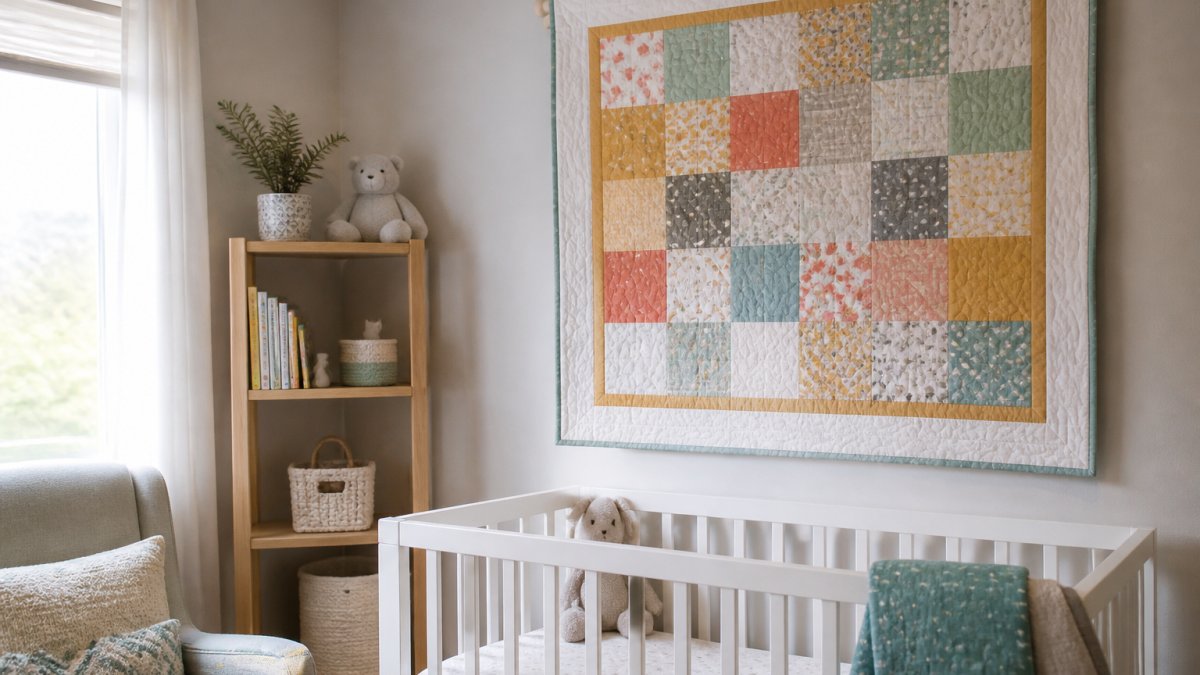
Safe display: where the quilt should and should not go
A quilt is decor, not a sleep surface. Health authorities consistently advise keeping loose bedding, blankets, and pillows out of a crib for the first year, so the quilt should never be draped over the crib rail or laid inside the crib while a baby sleeps. Safe display means:
- On the wall, at least 12 inches above the top of the crib rail, so nothing can fall into the sleep space.
- On a shelf or ladder that is anchored to the wall and out of reach of a standing toddler.
- Over the back of a rocking chair or glider, where it is decorative and supervised, not in the crib.
Use the quilt for tummy time on the floor, for stroller outings, and for display. Let a fitted sheet do the sleeping.
Hanging methods that protect the fabric
The goal is to support the quilt's weight without stressing the stitches. A few methods do that well:
- Quilt hanger with a rod: the quilt slips into a fabric sleeve sewn to the back, or clips along a wooden bar, spreading weight evenly across the top edge. This is the best choice for a quilt you plan to keep on the wall long-term.
- Folding rack or ladder: a folded quilt draped over a rail looks intentional and avoids hardware on the wall. Use a ladder with a wide rung so the fold does not crease sharply.
- Shelf styling: fold the quilt in thirds and place it on an open shelf, pattern edge facing out. This works well for smaller 35" x 36" quilts and keeps the piece usable.
Avoid pinning directly through the quilt face, and avoid hanging it in direct sun. Prolonged sunlight fades cotton, and a north-facing wall will keep the colors true far longer.
Measurements and placement that look right
A few numbers make the difference between a quilt that looks hung and one that looks placed:
- Wall height: hang the center of the quilt at roughly 57-60 inches from the floor, the same height as framed art, so it reads at eye level.
- Above the crib: leave 12-18 inches between the bottom of the quilt and the top of the crib rail. Closer feels crowded; farther leaves the quilt floating.
- Width relative to furniture: a wall quilt should span about two-thirds to three-quarters of the width of the crib or dresser beneath it. A 41" x 50" quilt suits a standard crib; a 35" x 36" square suits a narrow wall or a shelf.
Rotating and seasonal display
A quilt displayed in one spot for years will fade unevenly. Rotate it every three to six months, swap the wall for the shelf, or fold it a different way, so light hits different areas. Store the quilt folded in a breathable cotton bag between rotations, and refold along different lines each time to avoid permanent creases.
Washing, Storing, and Preserving a Keepsake Quilt
A handmade quilt is washable, and it should be washed. Cotton quilts with natural batting handle gentle machine washing well; the fabric softens and the quilt gains the crinkled texture that people associate with heirloom pieces.
The routine that works:
- Machine wash cold on a gentle cycle with a mild detergent.
- Skip bleach and fabric softener.
- Tumble dry low, then remove promptly, or line dry.
- Store folded in a cool, dry place away from direct light.
For long-term storage, avoid sealed plastic, which traps moisture. A cotton pillowcase or a breathable storage bag is the safer choice. If the quilt is purely decorative, wash it once a year; if it is in daily use, wash it as needed.
Choosing Your Nursery Quilt From Eboni & Comfort LLC
Choosing comes down to three questions: what size fits the room, which palette matches the walls, and whether the piece will be used or displayed. Answer those and the shortlist is short.
Our own catalog covers the range. The Sweet Dream Artisan Quilt is a 43 by 60 inch piece with sapphire and turquoise frames and illustrated pegasi, backed in cotton fleece and filled with natural batting, which suits a toddler bed or a bedroom accent.

On the question of proof: ask any seller for close-up photos of the stitching and the back of the quilt. A maker will send them. A reseller usually will not.
Frequently Asked Questions
How can you decorate a nursery with a handmade quilt?
Use the quilt as the room's visual anchor rather than just bedding. Hang it on the wall above the crib or on a quilt ladder, drape it over a rocking chair, or fold it on an open shelf. Pick one display spot so the quilt reads as art, then pull two or three colors from its pattern into curtains, a rug, or a lampshade. The Baby Blue Artisan Quilt, for example, pairs sage green and golden ochre with a puppy print, giving you a ready-made palette for a gender-neutral nursery.
How do you choose a quilt color for a nursery?
Start with the mood you want and work from the quilt outward. Soft blues, creams, and sage greens create a calm room, while berry, rose, and rainbow tones suit a playful space. If the nursery already has a wall color, choose a handmade quilt that shares one shade with it and adds one contrast. A quilt with a strong palette, like the sapphire and turquoise Sweet Dream Artisan Quilt, can carry a room on its own without repainting.
Can you hang a quilt on a nursery wall?
Yes, and it is one of the safest ways to use a handmade quilt in a nursery. Mount it well above the crib and out of a toddler's reach using a wooden quilt hanger, a fabric sleeve sewn to the back, or museum putty on a lightweight rod. Keep it away from direct sunlight to slow fading, and check the hardware every few months. A wall hanging keeps the quilt visible as decor while keeping loose fabric out of the sleep space.
What size quilt is best for a nursery?
For tummy time, stroller use, and display, a square around 35 by 36 inches works well, which is the size of the Baby Blue Artisan Quilt. For a toddler bed cover or a larger wall piece, look at roughly 43 by 60 inches, like the Sweet Dream Artisan Quilt. A 41 by 50 inch quilt, such as the Wise Old Owl Quilt, sits between the two and suits a wall hanging or lap quilt. Measure your wall or chair before buying.
A nursery quilt should outlast the crib, and that is the standard we build to. If you want a piece that moves from play mat to wall hanging to keepsake, browse the handmade quilts for sale and pick the palette that fits your room. Every Eboni & Comfort LLC quilt is handcrafted, machine washable, and made to be used rather than stored away.
